Compare IOP and PHP to understand treatment schedules, support levels, and how a clinical assessment helps determine the right outpatient care for your needs.
After a treatment centre recommends PHP or IOP, you may still be unsure what the programme would mean for your week. How much help would you receive, and what happens once you leave each session?
Whether you need addiction treatment yourself or support a loved one, it helps to understand the difference between PHP and IOP.
In this guide, we’ll compare the programmes and explain what clinicians consider before they recommend care.
Key Takeaways
- PHP provides more intensive daytime care, while IOP offers structured treatment with a lighter schedule.
- Under Medicare coverage rules, PHP requires at least 20 weekly service hours and IOP requires nine.
- A clinical assessment considers your current symptoms, withdrawal risk and ability to manage safely between sessions.
- Both programmes require a suitable living arrangement and reliable support outside treatment.
- Therapy and psychiatric services vary, so ask what your proposed programme includes.
- Treatment length varies, and either programme can come first. Your team can adjust care as needs change.
- Legends Recovery can discuss Cleveland programmes and help verify your insurance benefits.
IOP vs PHP: What Is the Difference?
PHP (Partial Hospitalization Program) provides more intensive daytime care than IOP (Intensive Outpatient Program), and a clinical assessment of your needs and safety between sessions determines the appropriate option.
Both offer structured care while you live outside an overnight treatment setting.
Here are the main differences.
| Factor | PHP | IOP |
|---|---|---|
| Treatment intensity | More intensive daytime treatment | Less intensive treatment with regular support |
| General attendance pattern | Fuller treatment days, often across most weekdays | Shorter sessions across several days |
| Medicare minimum weekly services | At least 20 hours | At least 9 hours |
| Clinical contact and oversight | More frequent contact. Available services vary | Scheduled contact. Available services vary |
| Overnight stay | No overnight stay within the clinical programme | No overnight stay within the clinical programme |
The partial hospitalization program is structured outpatient day treatment. Despite the name, a PHP can operate in a hospital department or a community facility.
You can read about our partial hospitalisation programme in Ohio for the addiction-treatment option we offer.
An intensive outpatient programme gives you structured treatment with a lighter time commitment. Both levels provide more support than ordinary weekly therapy, and accommodation arrangements need to be considered separately.
The table’s hours come from CMS’s 2026 Medicare guidance. They are coverage requirements, and individual programmes may provide more hours. Actual attendance patterns also vary, so ask for the provider’s current timetable.
For a closer look at how PHP and IOP compare, this video covers what to expect and what to ask before starting treatment.
How Do Clinicians Decide Whether You Need PHP or IOP?
Clinicians recommend PHP or IOP after assessing your clinical needs and your safety between sessions. We recommend bringing examples to a PHP vs IOP assessment so the team understands your difficulties outside appointments.
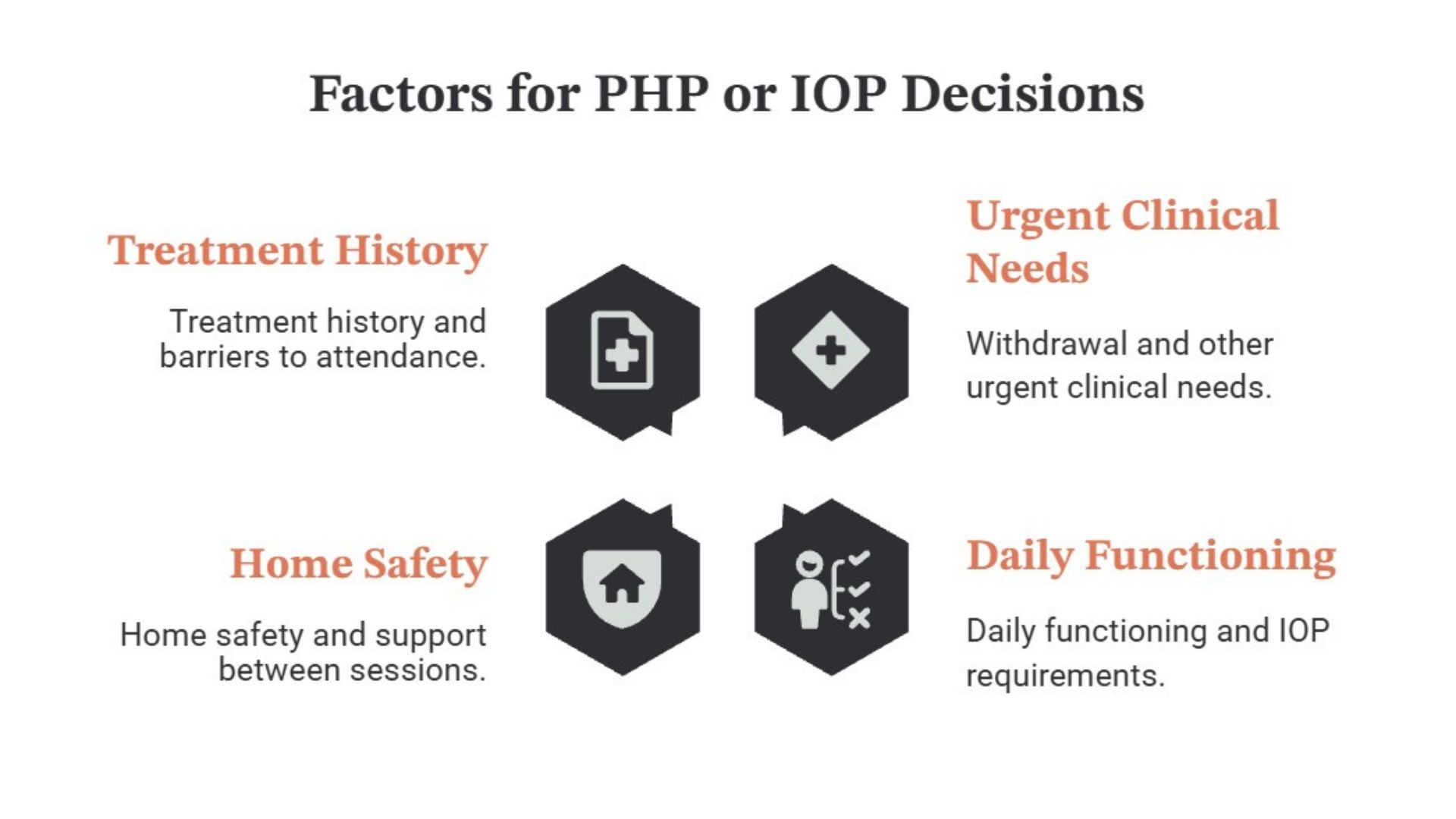
Here’s what the team will assess, from withdrawal risks to the support available between sessions.
Withdrawal and Other Urgent Clinical Needs
Withdrawal risk and medical stability need attention before outpatient placement. Depending on your situation, the assessment may point to medically supervised detox or another care setting.
Mental health symptoms matter too. A diagnosis alone doesn’t establish the level you need, so the team considers how symptoms affect your safety and ability to participate.
Co-occurring concerns should form part of the addiction-treatment assessment. Information about current medication and recent substance use also helps that assessment.
PHP and IOP have limits when immediate medical attention or continuous supervision is necessary. If there is immediate danger, call 911. For a suicide or mental health crisis, call or text 988.
Daily Functioning and IOP Requirements
Daily functioning includes basic self-care and the ability to keep a routine. Clinicians also consider whether you can participate in sessions and use coping skills when professional support is less immediate.
Example: Someone gets through every workday but drinks heavily each evening and regularly skips meals. They have also missed appointments and struggle to concentrate at home. Their employment doesn’t settle the care decision. A clinician still needs to understand how they cope outside work and what additional support would help.
Eligibility comes from that assessment alongside the programme’s admission criteria. We recommend asking what the provider requires for participation. The Medicare hours shown above describe coverage rules. They don’t establish someone’s clinical suitability on their own.
Home Safety and Support Between Sessions
The place you return to matters in both programmes. If other people use substances there, or reliable support is difficult to reach, tell the treatment team. If you live alone, discuss who you could contact.
More daytime care still leaves evenings and nights to plan for. The team may need to consider recovery housing or another setting that addresses your situation.
Housing and clinical treatment are separate arrangements. Ask where you would stay and what support would be available there. Accommodation should be discussed directly with the provider before you make plans.
Treatment History and Barriers to Attendance
Recent treatment helps the team understand what has helped and where difficulties remain. Worsening symptoms or limited progress may also affect the recommendation.
Bring details of recent care and current concerns. Include the names of any previous programmes. Then compare the actual IOP vs PHP program schedules with your commitments. Transport, work, and childcare can make attendance difficult, so discuss those barriers with the team.
We recommend asking how appropriate care could be made workable. Admissions can also help check benefits. Our explanation of how insurance coverage for rehab works provides background for that conversation.
What Happens During PHP and IOP Sessions?
PHP and IOP sessions may include group work and coping-skills practice, alongside individual appointments and psychiatric support where provided. The mix depends on the programme and your plan.
IOP therapy can give you a place to work through difficulties that arise outside treatment. In a hypothetical session, you might identify a trigger, such as an argument that brings on an urge to drink. Then you could rehearse a response with the therapist, such as leaving the situation and contacting someone in your support network.
That practice gives you something concrete to try. Ask which appointments and services your proposed programme actually includes.

Why Does Continuing Support Matter After IOP?
Continuing support gives you ways to address difficulties as formal treatment becomes less frequent.
A Philadelphia randomized trial of 262 adults with alcohol use disorder compared added support with standard care. All participants received IOP. Over 12 months, heavy drinking occurred on an average of 10.29% of days with standard care versus 5.41% with added telephone support.
Published in Addiction in 2022, the study measured heavy-drinking days. It supports discussing continuing care with your team, without establishing a recovery rate or comparing PHP with IOP.
Find the Right Outpatient Support at Legends Recovery
At Legends Recovery, we offer PHP, IOP, and standard outpatient care in Cleveland. If you’re comparing IOP vs PHP, we can discuss your needs, any clinical recommendations, and available programmes.
For intensive outpatient program addiction treatment, ask which therapies and support your plan would include. Our admissions team can also verify your insurance benefits and discuss expected costs and approval requirements.
Contact our admissions team today to take the next step in getting the support you need.
FAQs
How Long Is PHP Treatment?
PHP treatment length depends on your clinical needs and response to care. Ask about the expected timeframe and when progress will be reviewed. That estimate may change as your needs change.
How Long Does IOP Treatment Last?
IOP treatment length varies by programme and individual needs. Ask your provider about the expected timeframe and when progress will be reviewed. Your team may adjust that timeframe as your needs change.
What Comes First, PHP or IOP?
Either can come first. It depends on your clinical assessment. There is no fixed PHP vs IOP program sequence. Some people move from PHP to IOP, while others enter IOP directly or need more intensive support later. Your team can adjust care as your needs change.
Compare IOP and PHP to understand treatment schedules, support levels, and how a clinical assessment helps determine the right outpatient care for your needs.
After a treatment centre recommends PHP or IOP, you may still be unsure what the programme would mean for your week. How much help would you receive, and what happens once you leave each session?
Whether you need addiction treatment yourself or support a loved one, it helps to understand the difference between PHP and IOP.
In this guide, we’ll compare the programmes and explain what clinicians consider before they recommend care.
Key Takeaways
- PHP provides more intensive daytime care, while IOP offers structured treatment with a lighter schedule.
- Under Medicare coverage rules, PHP requires at least 20 weekly service hours and IOP requires nine.
- A clinical assessment considers your current symptoms, withdrawal risk and ability to manage safely between sessions.
- Both programmes require a suitable living arrangement and reliable support outside treatment.
- Therapy and psychiatric services vary, so ask what your proposed programme includes.
- Treatment length varies, and either programme can come first. Your team can adjust care as needs change.
- Legends Recovery can discuss Cleveland programmes and help verify your insurance benefits.
IOP vs PHP: What Is the Difference?
PHP (Partial Hospitalization Program) provides more intensive daytime care than IOP (Intensive Outpatient Program), and a clinical assessment of your needs and safety between sessions determines the appropriate option.
Both offer structured care while you live outside an overnight treatment setting.
Here are the main differences.
| Factor | PHP | IOP |
|---|---|---|
| Treatment intensity | More intensive daytime treatment | Less intensive treatment with regular support |
| General attendance pattern | Fuller treatment days, often across most weekdays | Shorter sessions across several days |
| Medicare minimum weekly services | At least 20 hours | At least 9 hours |
| Clinical contact and oversight | More frequent contact. Available services vary | Scheduled contact. Available services vary |
| Overnight stay | No overnight stay within the clinical programme | No overnight stay within the clinical programme |
The partial hospitalization program is structured outpatient day treatment. Despite the name, a PHP can operate in a hospital department or a community facility.
You can read about our partial hospitalisation programme in Ohio for the addiction-treatment option we offer.
An intensive outpatient programme gives you structured treatment with a lighter time commitment. Both levels provide more support than ordinary weekly therapy, and accommodation arrangements need to be considered separately.
The table’s hours come from CMS’s 2026 Medicare guidance. They are coverage requirements, and individual programmes may provide more hours. Actual attendance patterns also vary, so ask for the provider’s current timetable.
For a closer look at how PHP and IOP compare, this video covers what to expect and what to ask before starting treatment.
How Do Clinicians Decide Whether You Need PHP or IOP?
Clinicians recommend PHP or IOP after assessing your clinical needs and your safety between sessions. We recommend bringing examples to a PHP vs IOP assessment so the team understands your difficulties outside appointments.
Here’s what the team will assess, from withdrawal risks to the support available between sessions.
Withdrawal and Other Urgent Clinical Needs
Withdrawal risk and medical stability need attention before outpatient placement. Depending on your situation, the assessment may point to medically supervised detox or another care setting.
Mental health symptoms matter too. A diagnosis alone doesn’t establish the level you need, so the team considers how symptoms affect your safety and ability to participate.
Co-occurring concerns should form part of the addiction-treatment assessment. Information about current medication and recent substance use also helps that assessment.
PHP and IOP have limits when immediate medical attention or continuous supervision is necessary. If there is immediate danger, call 911. For a suicide or mental health crisis, call or text 988.
Daily Functioning and IOP Requirements
Daily functioning includes basic self-care and the ability to keep a routine. Clinicians also consider whether you can participate in sessions and use coping skills when professional support is less immediate.
Example: Someone gets through every workday but drinks heavily each evening and regularly skips meals. They have also missed appointments and struggle to concentrate at home. Their employment doesn’t settle the care decision. A clinician still needs to understand how they cope outside work and what additional support would help.
Eligibility comes from that assessment alongside the programme’s admission criteria. We recommend asking what the provider requires for participation. The Medicare hours shown above describe coverage rules. They don’t establish someone’s clinical suitability on their own.
Home Safety and Support Between Sessions
The place you return to matters in both programmes. If other people use substances there, or reliable support is difficult to reach, tell the treatment team. If you live alone, discuss who you could contact.
More daytime care still leaves evenings and nights to plan for. The team may need to consider recovery housing or another setting that addresses your situation.
Housing and clinical treatment are separate arrangements. Ask where you would stay and what support would be available there. Accommodation should be discussed directly with the provider before you make plans.
Treatment History and Barriers to Attendance
Recent treatment helps the team understand what has helped and where difficulties remain. Worsening symptoms or limited progress may also affect the recommendation.
Bring details of recent care and current concerns. Include the names of any previous programmes. Then compare the actual IOP vs PHP program schedules with your commitments. Transport, work, and childcare can make attendance difficult, so discuss those barriers with the team.
We recommend asking how appropriate care could be made workable. Admissions can also help check benefits. Our explanation of how insurance coverage for rehab works provides background for that conversation.
What Happens During PHP and IOP Sessions?
PHP and IOP sessions may include group work and coping-skills practice, alongside individual appointments and psychiatric support where provided. The mix depends on the programme and your plan.
IOP therapy can give you a place to work through difficulties that arise outside treatment. In a hypothetical session, you might identify a trigger, such as an argument that brings on an urge to drink. Then you could rehearse a response with the therapist, such as leaving the situation and contacting someone in your support network.
That practice gives you something concrete to try. Ask which appointments and services your proposed programme actually includes.
Why Does Continuing Support Matter After IOP?
Continuing support gives you ways to address difficulties as formal treatment becomes less frequent.
A Philadelphia randomized trial of 262 adults with alcohol use disorder compared added support with standard care. All participants received IOP. Over 12 months, heavy drinking occurred on an average of 10.29% of days with standard care versus 5.41% with added telephone support.
Published in Addiction in 2022, the study measured heavy-drinking days. It supports discussing continuing care with your team, without establishing a recovery rate or comparing PHP with IOP.
Find the Right Outpatient Support at Legends Recovery
At Legends Recovery, we offer PHP, IOP, and standard outpatient care in Cleveland. If you’re comparing IOP vs PHP, we can discuss your needs, any clinical recommendations, and available programmes.
For intensive outpatient program addiction treatment, ask which therapies and support your plan would include. Our admissions team can also verify your insurance benefits and discuss expected costs and approval requirements.
Contact our admissions team today to take the next step in getting the support you need.
FAQs
How Long Is PHP Treatment?
PHP treatment length depends on your clinical needs and response to care. Ask about the expected timeframe and when progress will be reviewed. That estimate may change as your needs change.
How Long Does IOP Treatment Last?
IOP treatment length varies by programme and individual needs. Ask your provider about the expected timeframe and when progress will be reviewed. Your team may adjust that timeframe as your needs change.
What Comes First, PHP or IOP?
Either can come first. It depends on your clinical assessment. There is no fixed PHP vs IOP program sequence. Some people move from PHP to IOP, while others enter IOP directly or need more intensive support later. Your team can adjust care as your needs change.